K — Dendritic Structural Encoding (KDSE): Deterministic Instantaneous Jump Magnitude from Compact Dendritic Structure
U.S. PATENT PENDING
© 2026 Mark Karaman
This work is licensed under the Creative Commons Attribution-ShareAlike 4.0 International License (CC BY-SA 4.0). To view a copy of this license, visit https://creativecommons.org/licenses/by-sa/4.0/
Reference implementations of KDSE (encoding, decoding, Ordered canonicalization, terminal-depth profile extraction, and the threshold-and-loss / instantaneous-jump-magnitude operators) are released under the GNU Affero General Public License v3.0 or later (AGPL-3.0-or-later) at:
https://github.com/uhware/kdse
Commercial licensing is available for parties who prefer not to use the AGPL or who require rights beyond those granted by the pending patent and the open-source licenses. Contact licensing@uhware.com for licensing terms.
Abstract
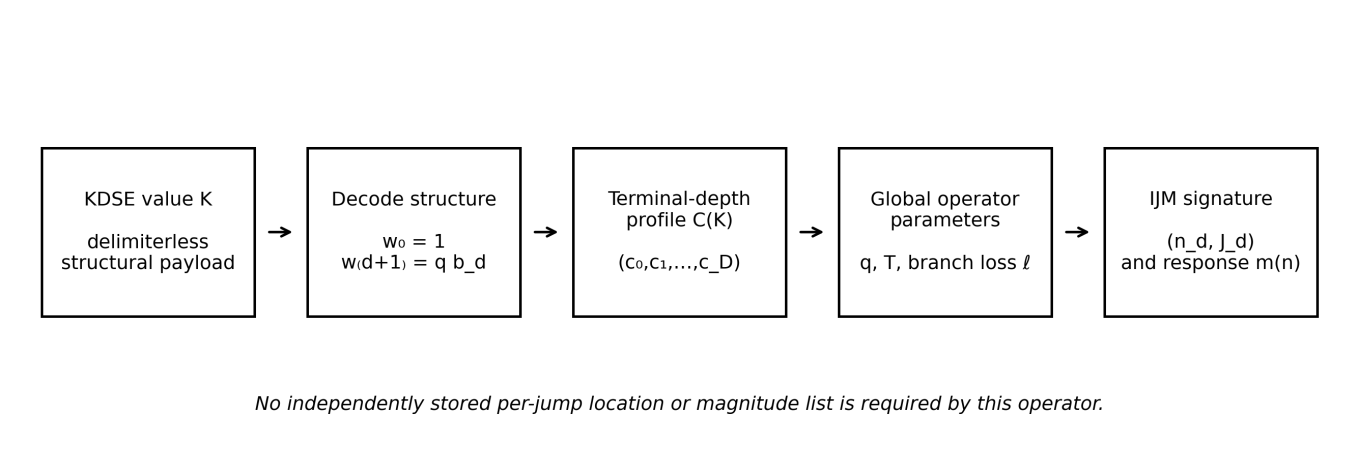
K — Dendritic Structural Encoding (KDSE) is a particular Dendritic Structural Encoding (DSE) that represents a finite rooted full q-ary dendritic structure as a compact branch/terminal value. Breadth-first level widths are derived from preceding branch counts, so explicit internal level delimiters are unnecessary and the deterministic final all-terminal level can be omitted. This paper isolates one operator-derived response attribute of that structure: instantaneous jump magnitude (IJM). Under equal q-way splitting, uniform multiplicative branch retention a = 1 − ℓ, and a common terminal threshold T, every occupied terminal depth d activates at n_d = T(q/a)^d and produces a finite output jump J_d = T c_d, where c_d is the number of terminals at that depth. Branch loss therefore changes jump location and post- activation slope but cancels from the jump magnitude. The normalized quantity J_d/T = c_d directly recovers terminal multiplicity. More generally, any terminal with positive multiplicative path transfer α_j that is thresholded at T and then contributes the transferred value enters the output with individual jump magnitude T at n_j = T/α_j; coincident terminals sum into grouped jumps. A KDSE value plus global operator parameters thus deterministically generates one or more response-event locations, gain increments, and jump magnitudes without an independently stored per-jump parameter list. Appendix A presents the complete Ordered KDSE-8 threshold × branch-loss response atlas. Discontinuous and thresholded activations are established mechanisms; the focus here is the deterministic structural generation of their response geometry.
1. Introduction
Finite jump discontinuities are established response mechanisms: a system remains on one side of an activation boundary and changes by a finite amount when that boundary is crossed. Such events may be parameterized directly by storing their locations, magnitudes, and post-activation gains. KDSE admits a different construction. A compact
dendritic structural value is decoded first; a simple operator then derives the response events from that structure and a small set of global parameters. The resulting relationship is compact and exact. Under equal q-way splitting, multiplicative branch loss, and a common terminal threshold, every occupied terminal depth produces one grouped response discontinuity. Its horizontal location depends on depth and path attenuation. Its vertical magnitude depends only on the threshold and the number of terminals that activate together. The same KDSE value that supplies those multiplicities remains a complete structural object and may be consumed by other operators. This paper is intentionally narrower than the general KDSE introduction [1]. Section 2 provides the minimum encoding definitions needed for the paper to stand alone. Sections 3–5 derive the threshold-and-loss response and formalize IJM, including the identity J_d = T c_d, normalized structural readout J_d/T = c_d, and the more general multiplicative path-transfer cancellation result. Sections 6–8 give worked examples, a direct construction algorithm, and the complete Ordered KDSE-8 IJM signatures. Neural-network relevance is noted only as context: no neural architecture is required for the results developed here.
2. KDSE in brief
KDSE denotes K — Dendritic Structural Encoding, the particular DSE construction used in this paper. Let q ≥ 2 be its structural arity. Every branch node has exactly q ordered children; every other node is terminal. Each explicit node is represented by one binary symbol: 1 for branch and 0 for terminal. The structural alphabet is therefore binary even when q is greater than two.
2.1 Delimiterless breadth-first structure
KDSE serializes explicit nodes level by level in breadth-first order. If wd is the number of explicit positions at depth d and bd is the number of branch symbols in that level, then
After a level is read, its branch count determines the exact width of the next level. Internal level boundaries therefore require no explicit delimiters. The final all-terminal level is deterministic and omitted; terminal children of branches in the final encoded level are reconstructed implicitly. The isolated terminal root is the single payload 0. In this paper, delimiterless refers only to these internal structural boundaries. A stream containing multiple variable-length KDSE values still requires outer framing, a container, an explicit length convention, or an untrimmed fixed-width representation.
| Payload | Derived level partition | Binary reconstructed meaning |
|---|---|---|
| 0 | 0 | Isolated terminal root. |
| 1 | 1 | Root branch; two implicit terminal children for q = 2. |
| 101 | 1 | 01 | One terminal at depth 1; two implicit terminals at depth 2. |
| 10101 | 1 | 01 | 01 | Terminals at depths 1, 2, and 3. |
2.2 Ordered form and terminal-depth profile
When sibling order is not an independent semantic property, KDSE selects the lowest numerical valid breadth-first serialization among sibling permutations as the canonical Ordered representative. This removes sibling-permutation synonyms while retaining one deterministic structural value. For the response operator studied here, the key intrinsic projection is the terminal-depth profile
where cd is the number of reconstructed terminals at depth d, including implicit terminals after the final encoded level. Equal q-way mass division gives the familiar conservation identity
The complete Ordered topology contains more information than C(K). Distinct Ordered KDSE values can therefore share the same terminal-depth profile and become indistinguishable to an operator that uses only C(K). This boundary will be visible in the complete atlas.
2.3 KDSE-8 study space
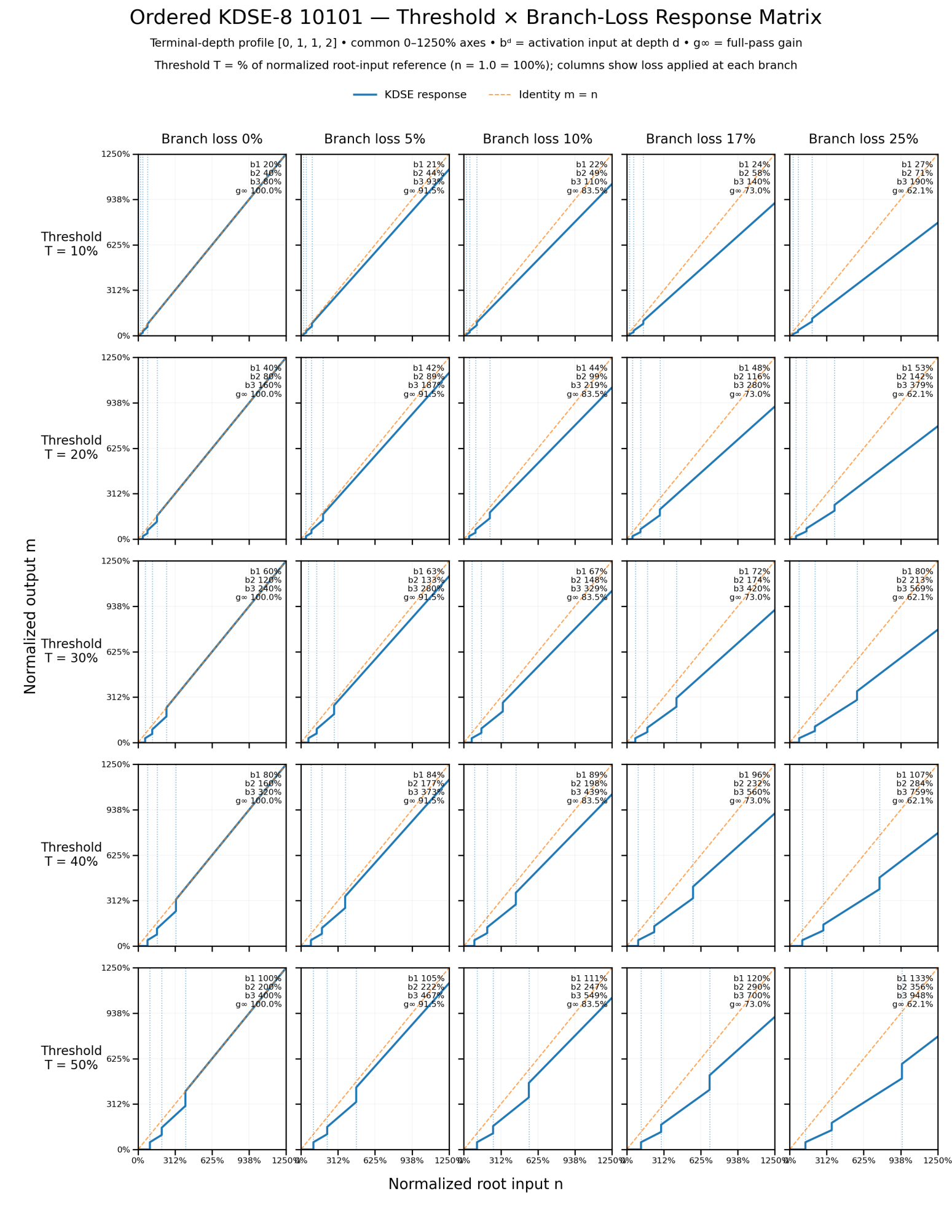
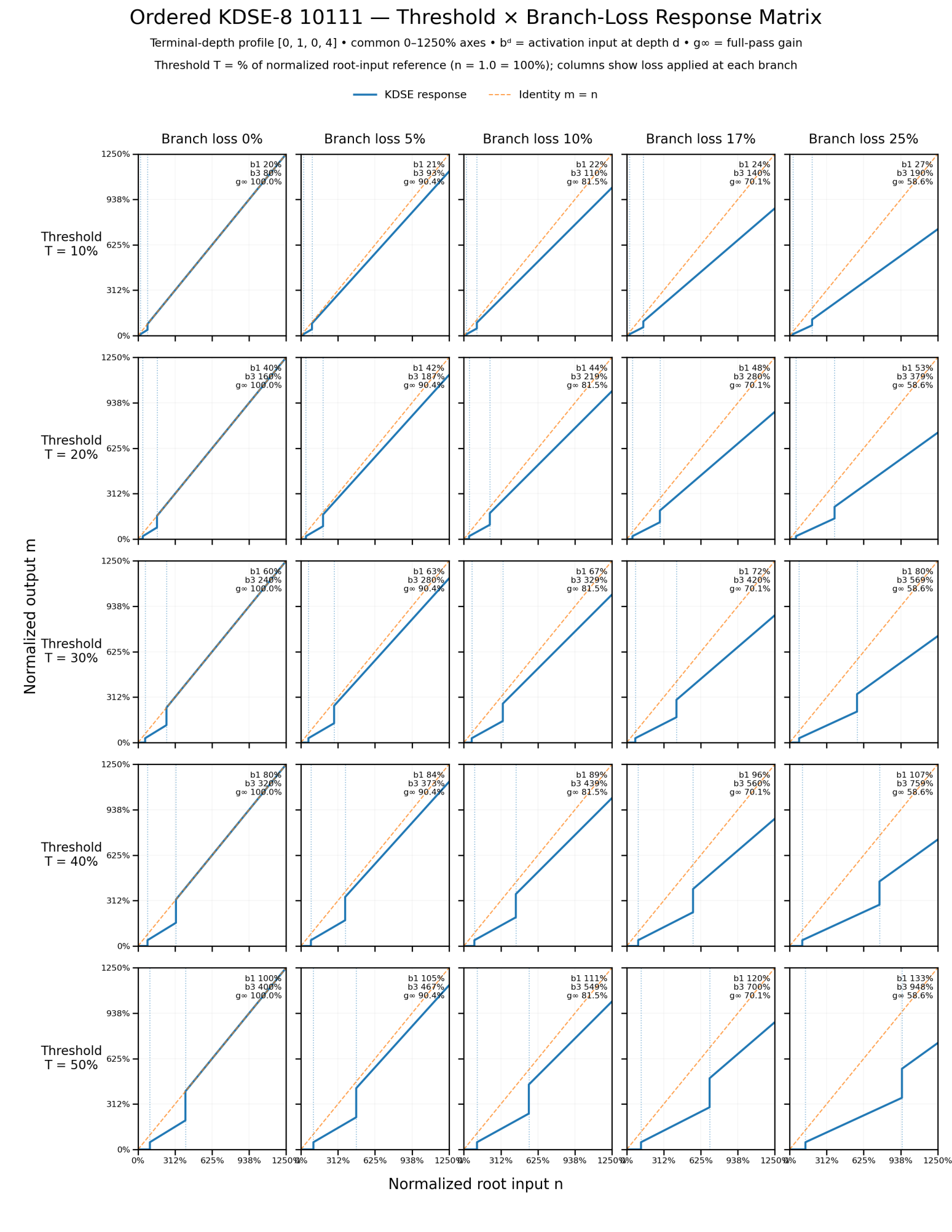
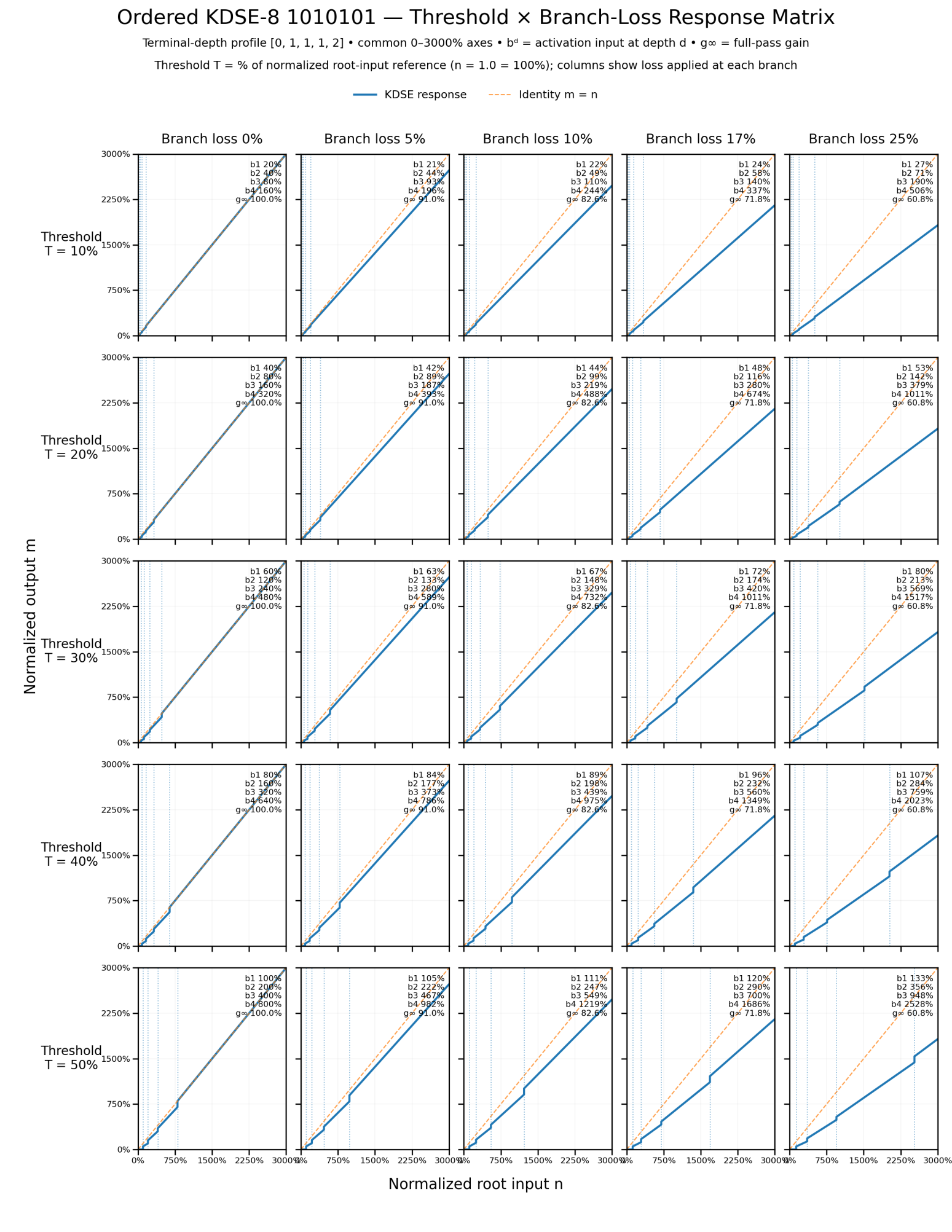
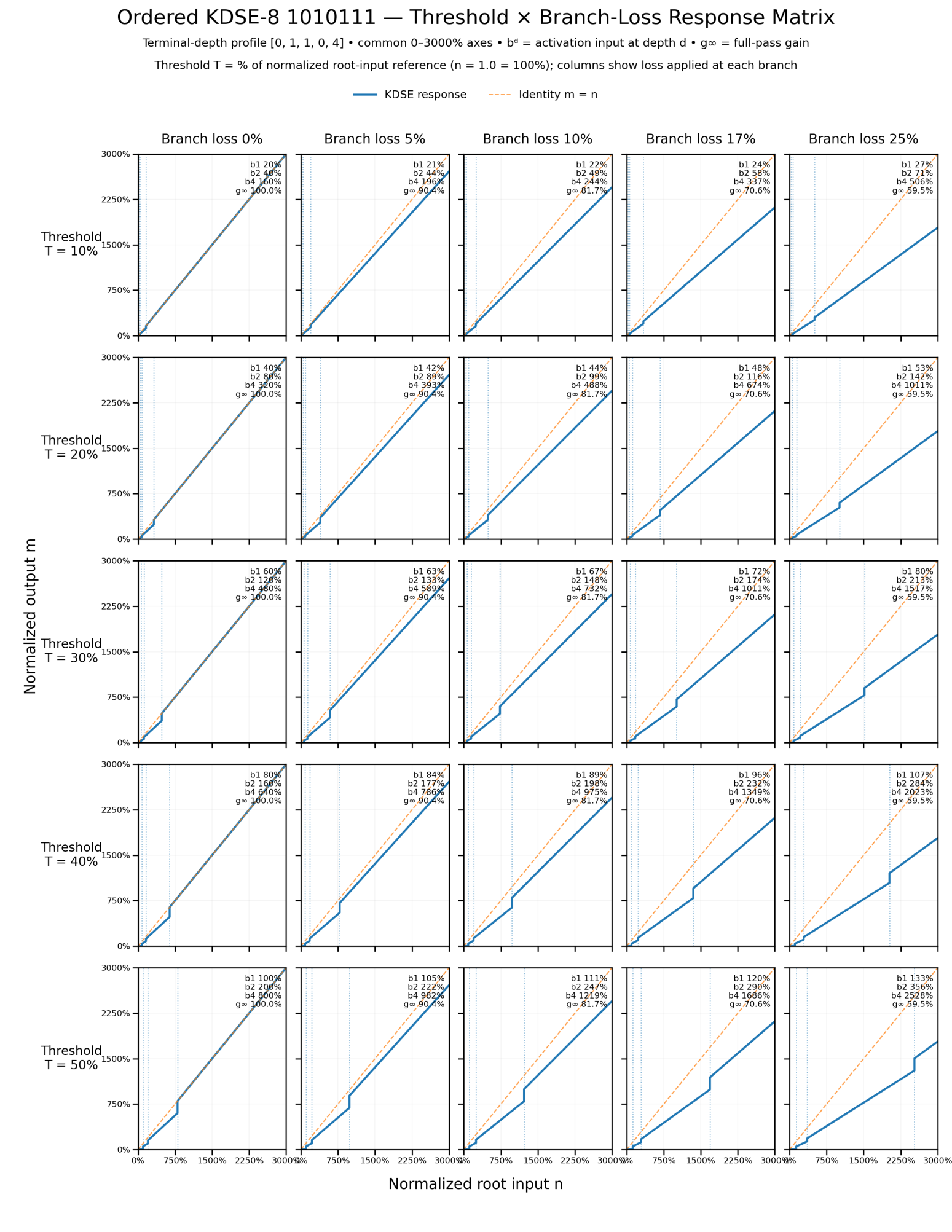
The binary KDSE-8 container class uses q = 2, a seven-symbol payload budget, and an eight-bit physical container with one bit unassigned outside the core payload. Valid minimal payload lengths are 1, 3, 5, and 7. The complete minimal-form space contains 38 valid payloads, which reduce under lowest-numerical sibling canonicalization to 13 Ordered values. Appendix A gives one threshold × branch-loss response sheet for each Ordered value.
2.4 Notation used in this paper
| Symbol | Meaning |
|---|---|
| K | Valid KDSE structural value. |
| q | Branching arity. |
| cd | Number of terminals at depth d. |
| n | Root input. |
| T | Terminal activation threshold. |
| ℓ | Multiplicative loss applied at each branch. |
| a = 1 − ℓ | Retained fraction per branch. |
| αd | Root-to-terminal transfer at depth d. |
| nd | Input at which depth d activates. |
| Δgd | Retained-gain increment at that activation. |
| Jd | Instantaneous jump magnitude at the depth-d activation. |
3. Threshold-and-loss response operator
Consider a nonnegative root input n and a positive threshold T. At every branch, the operator first retains the fraction a = 1 − ℓ of the incoming value and then divides that retained value equally among q children. Here 0 ≤ ℓ < 1,
so 0 < a ≤ 1. The branch-loss parameter ℓ is global in the principal operator; Section 4.4 later removes that uniformity assumption. Every terminal at depth d therefore receives
A terminal contributes its received value to the scalar output only when vd(n) ≥ T. Define the depth transfer coefficient
Summing the active terminal contributions gives the scalar response
For n > 0, define retained gain g(n) = m(n)/n. Between activation points, g(n) is constant and m(n) is linear through the origin. At an activation point, one or more previously suppressed terminal contributions enter simultaneously, producing a finite vertical jump in m(n).
3.1 Activation location and gain increment
When the depth-d terminal group activates, its retained-gain increment is
The activation location moves outward geometrically with depth. Increasing branch loss decreases a, pushing every non-root activation to a larger root input while reducing the slope contributed after activation.
4. Instantaneous jump magnitude
For a response discontinuity at input n*, define its instantaneous jump magnitude as the finite difference between the right- and left-hand output limits:
IJM measures the vertical response change at an activation boundary. For the depth-grouped KDSE operator of
Section 3, write Jd for the jump at nd.
4.1 Depth-group IJM theorem
Theorem 1 — KDSE depth-group instantaneous jump magnitude Under equal q-way splitting, uniform multiplicative branch loss, and a common terminal threshold, every occupied terminal depth d produces one grouped instantaneous jump at its activation input. Its magnitude is the threshold multiplied by the number of terminals at that depth.
Proof. Immediately below n_d, the c_d depth-d terminals contribute nothing. Immediately above n_d they contribute
c_d α_d n_d. Since n_d α_d = T,
The theorem separates two visually distinct properties of the response. Depth and branch transfer determine where an event occurs; terminal multiplicity and threshold determine how large the event is.
4.2 Branch-loss invariance
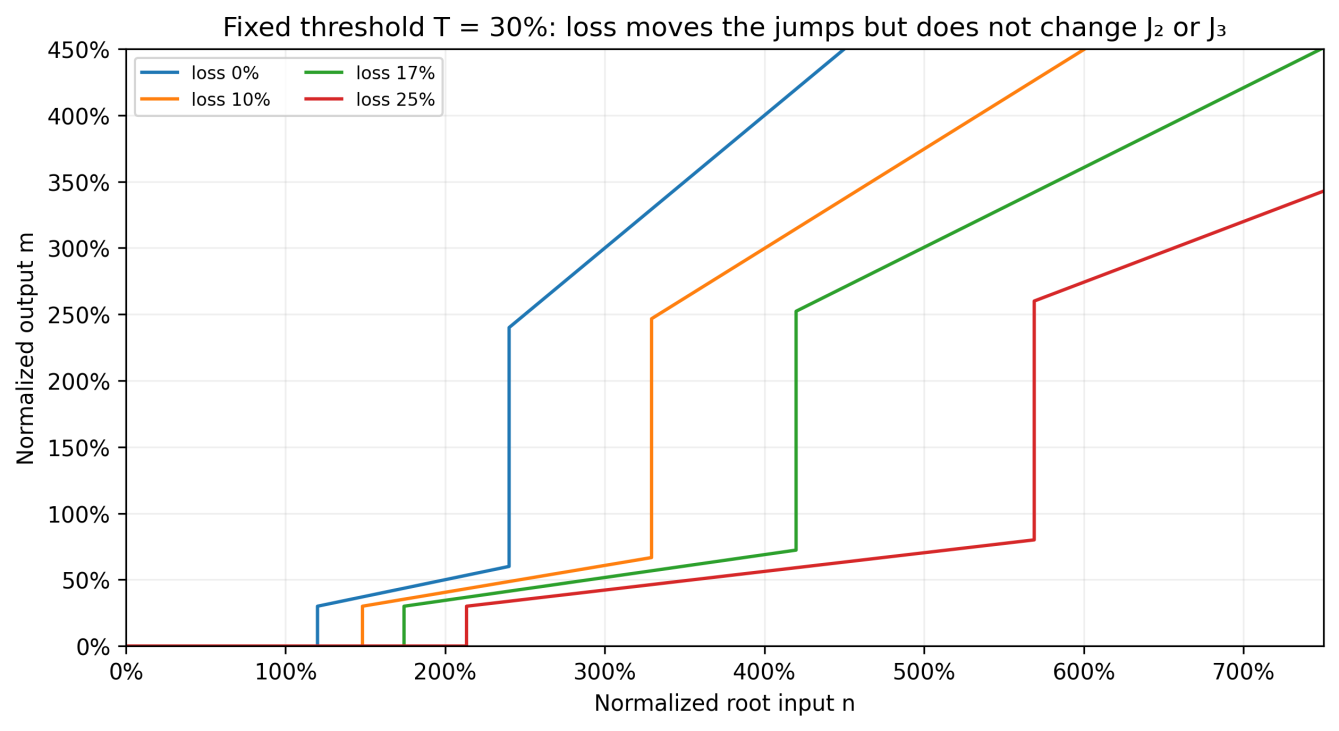
Corollary 1 (Branch-loss invariance). For fixed K and T, varying uniform branch loss changes activation location and post-activation gain but not the depth-group IJM. The location and gain increment contain reciprocal powers of a:
Multiplying the two quantities removes a:
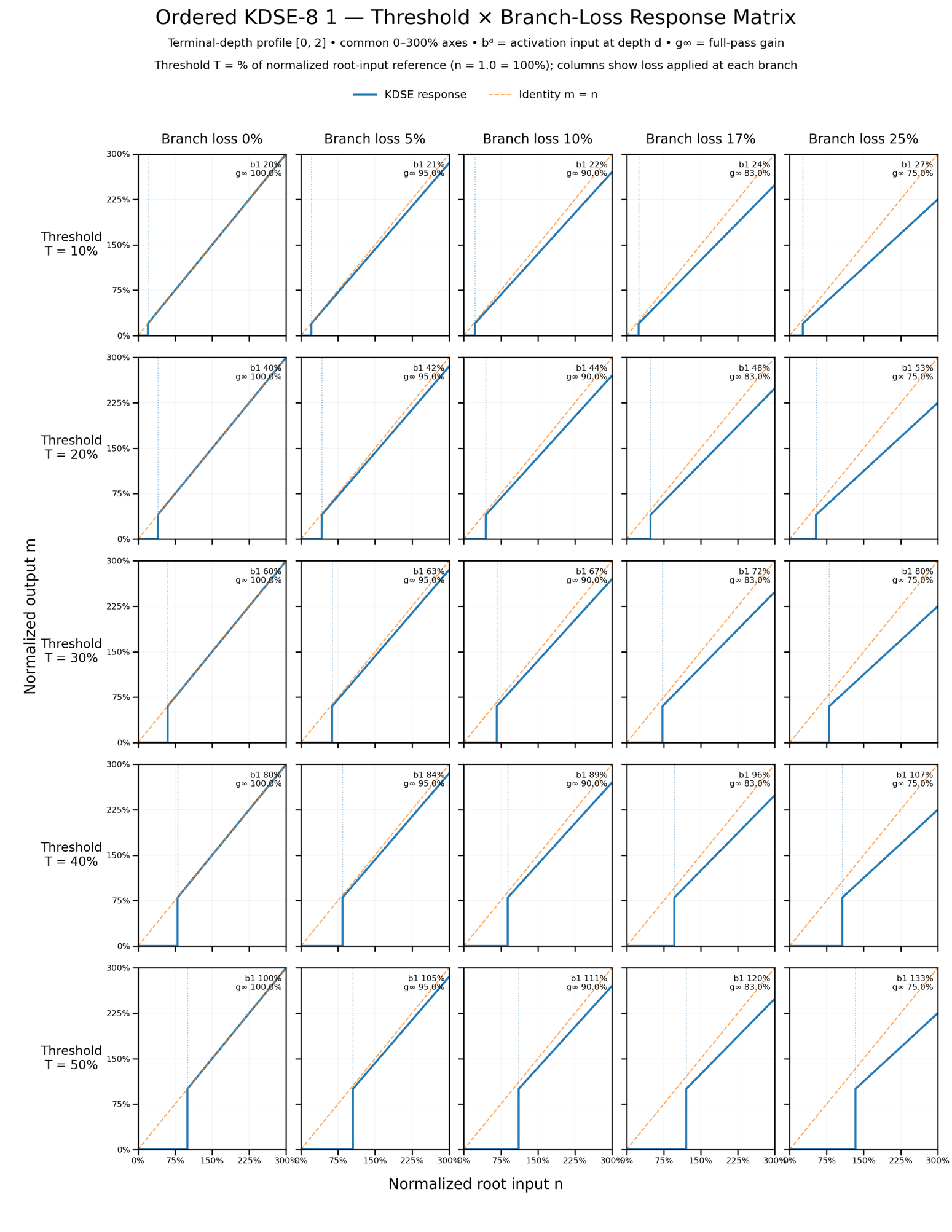
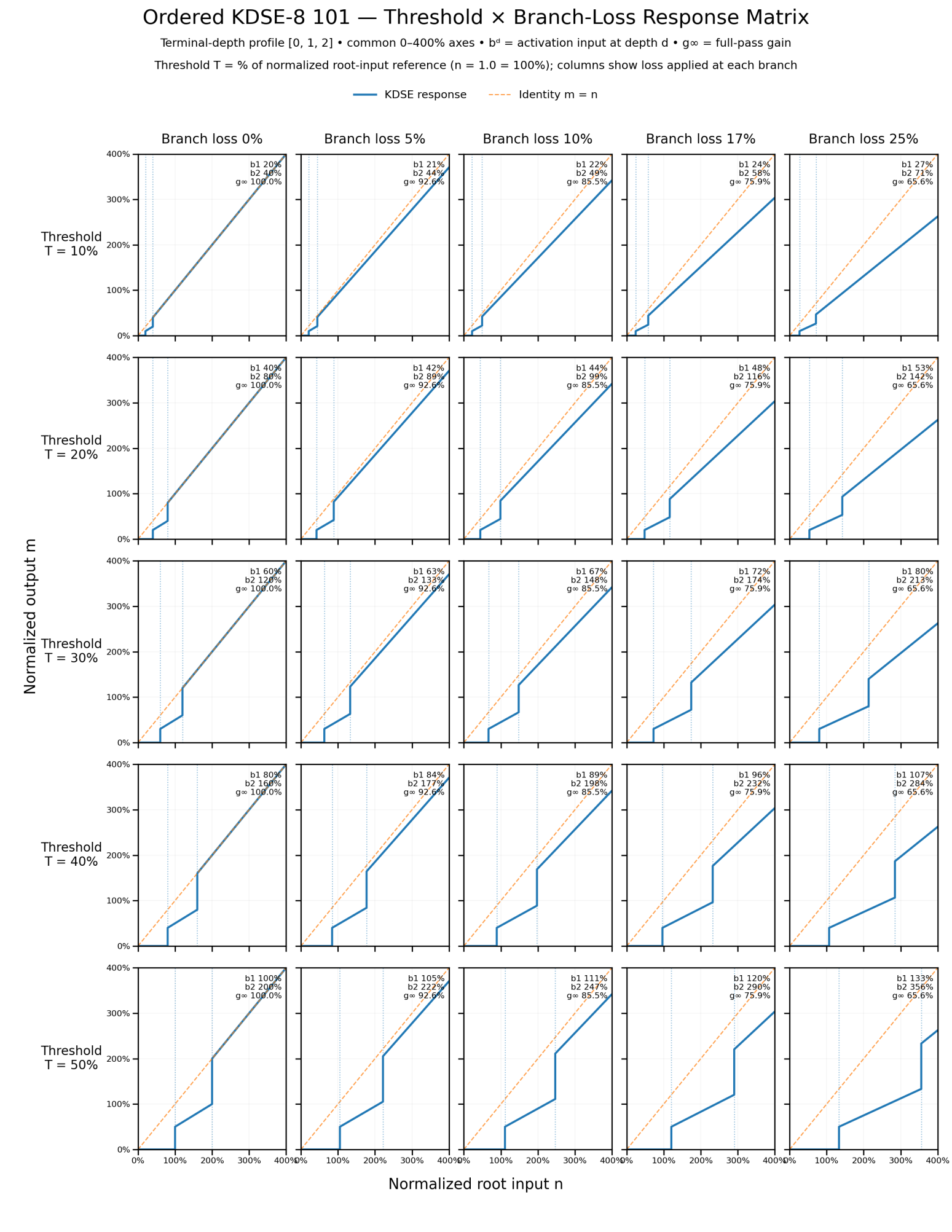
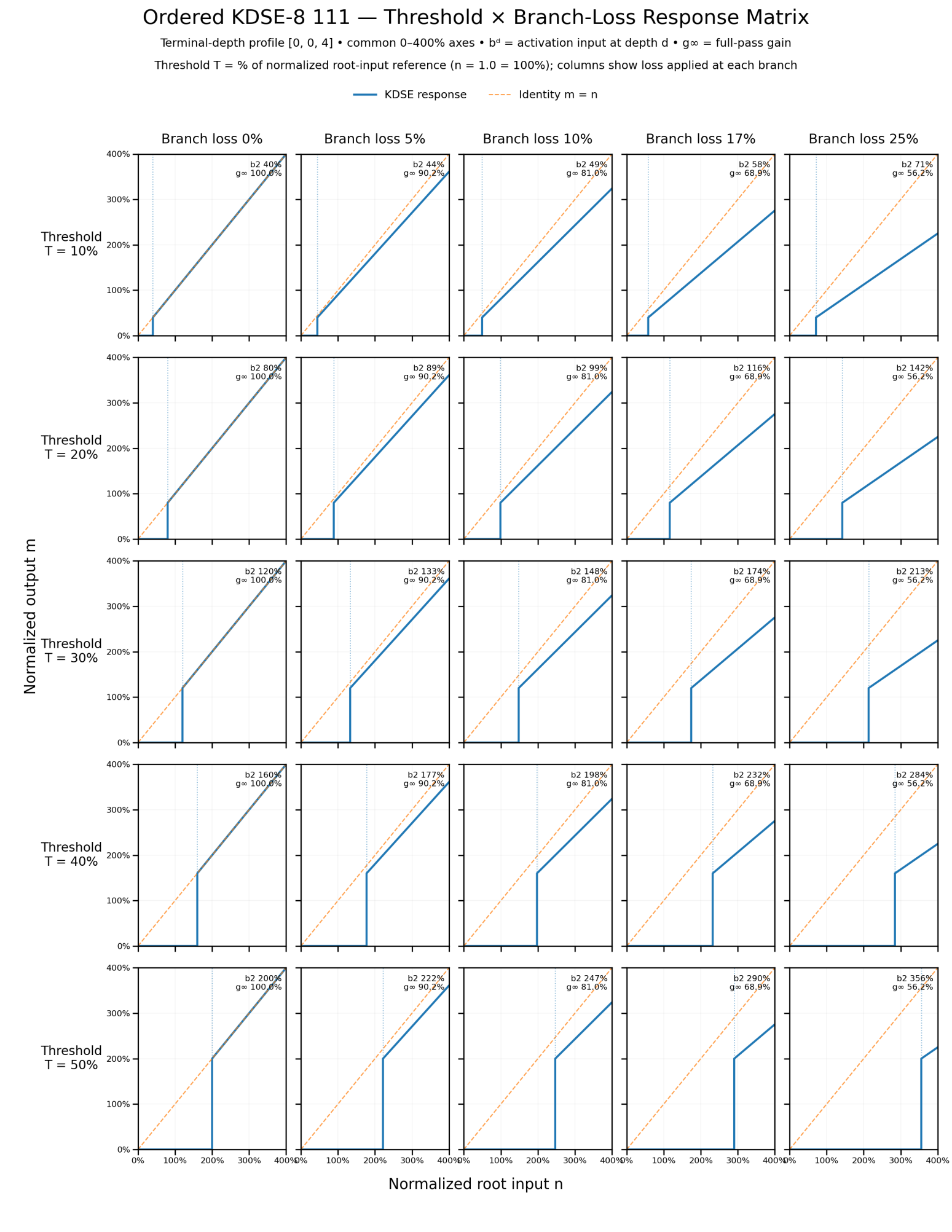
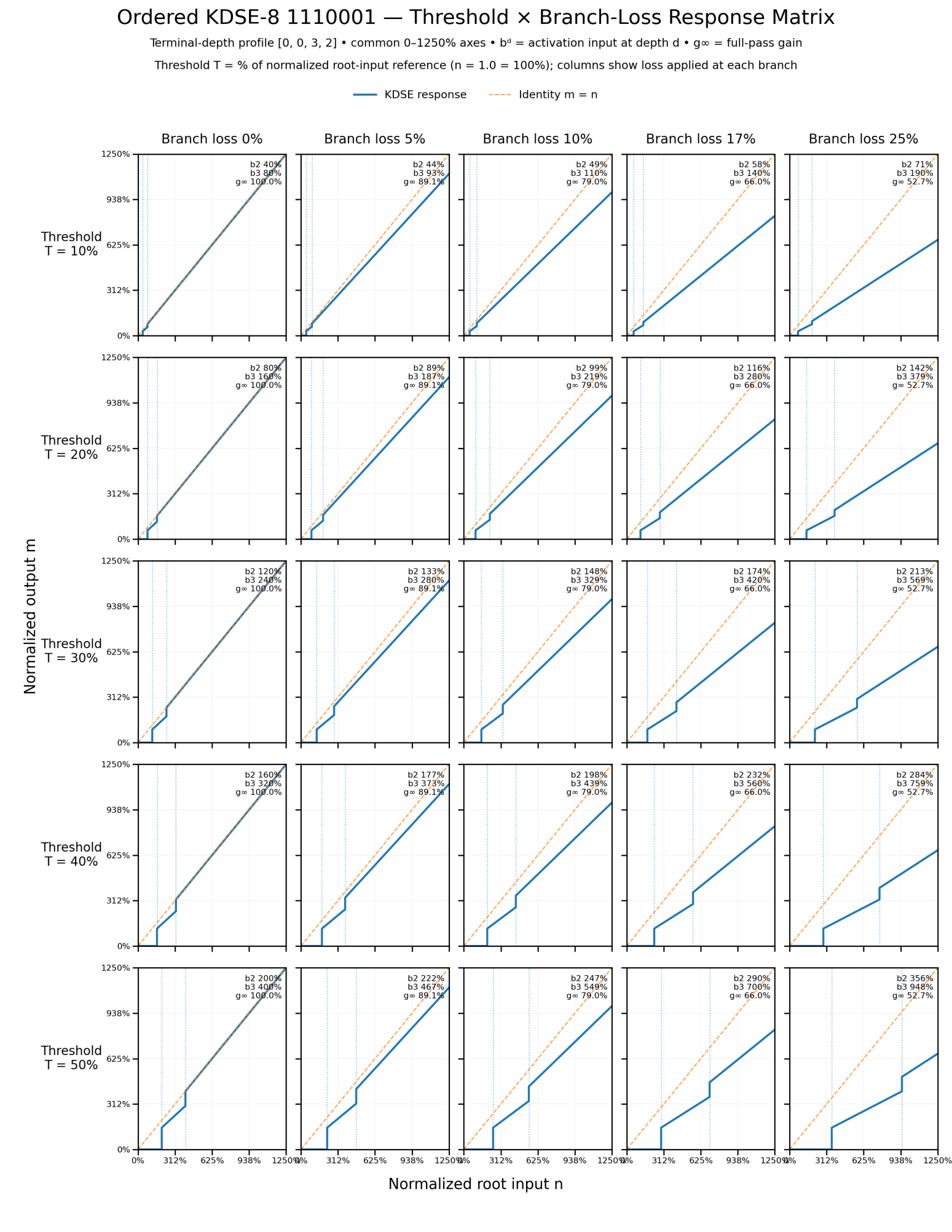
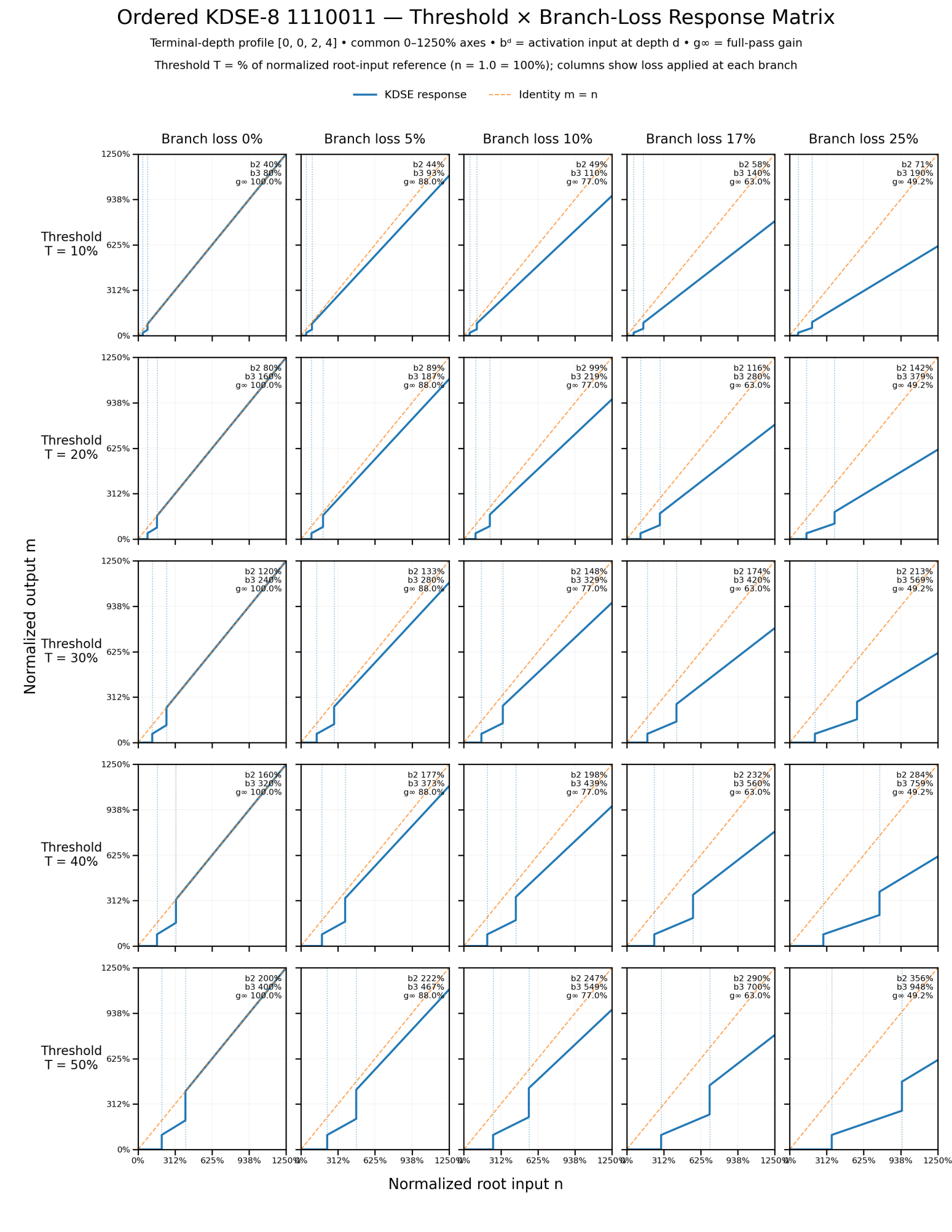
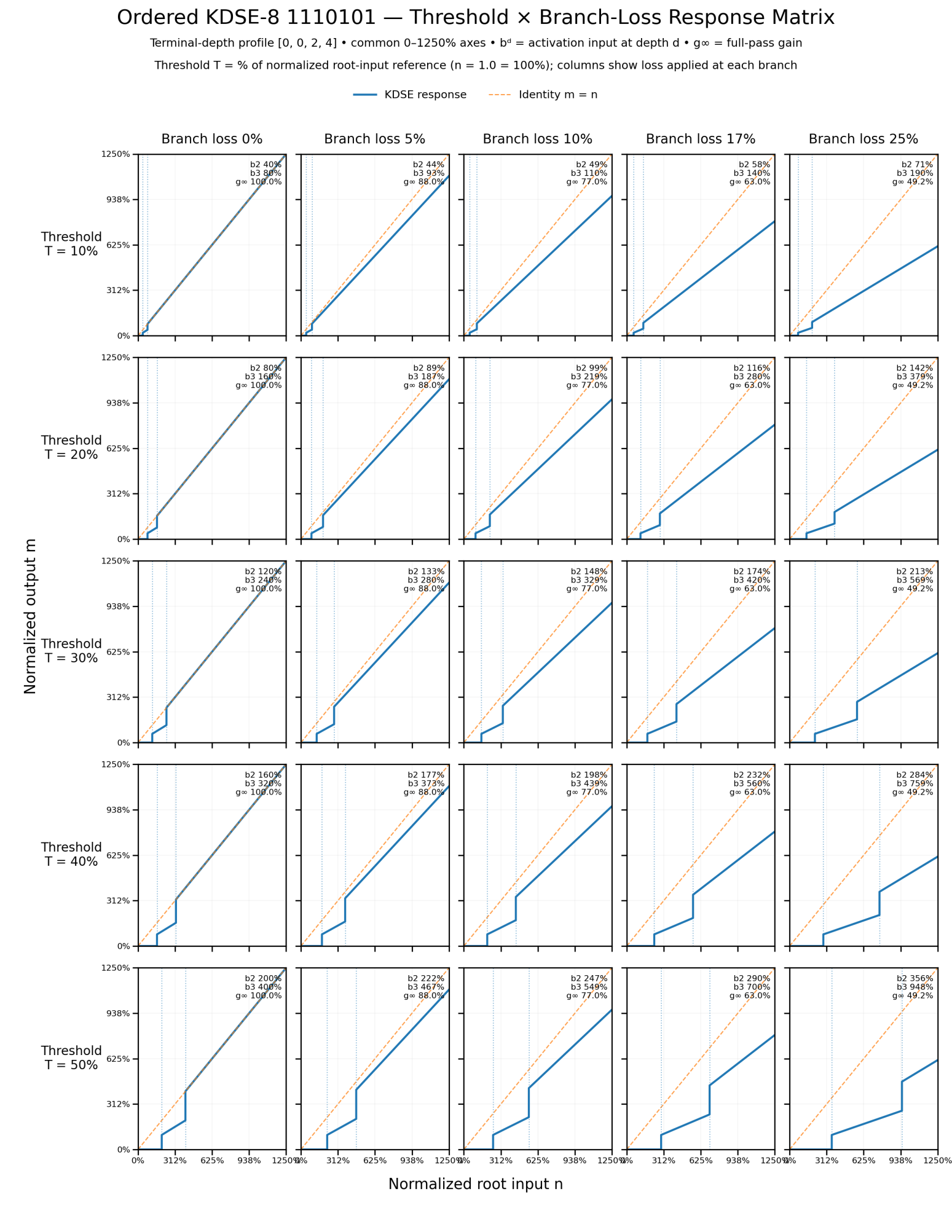
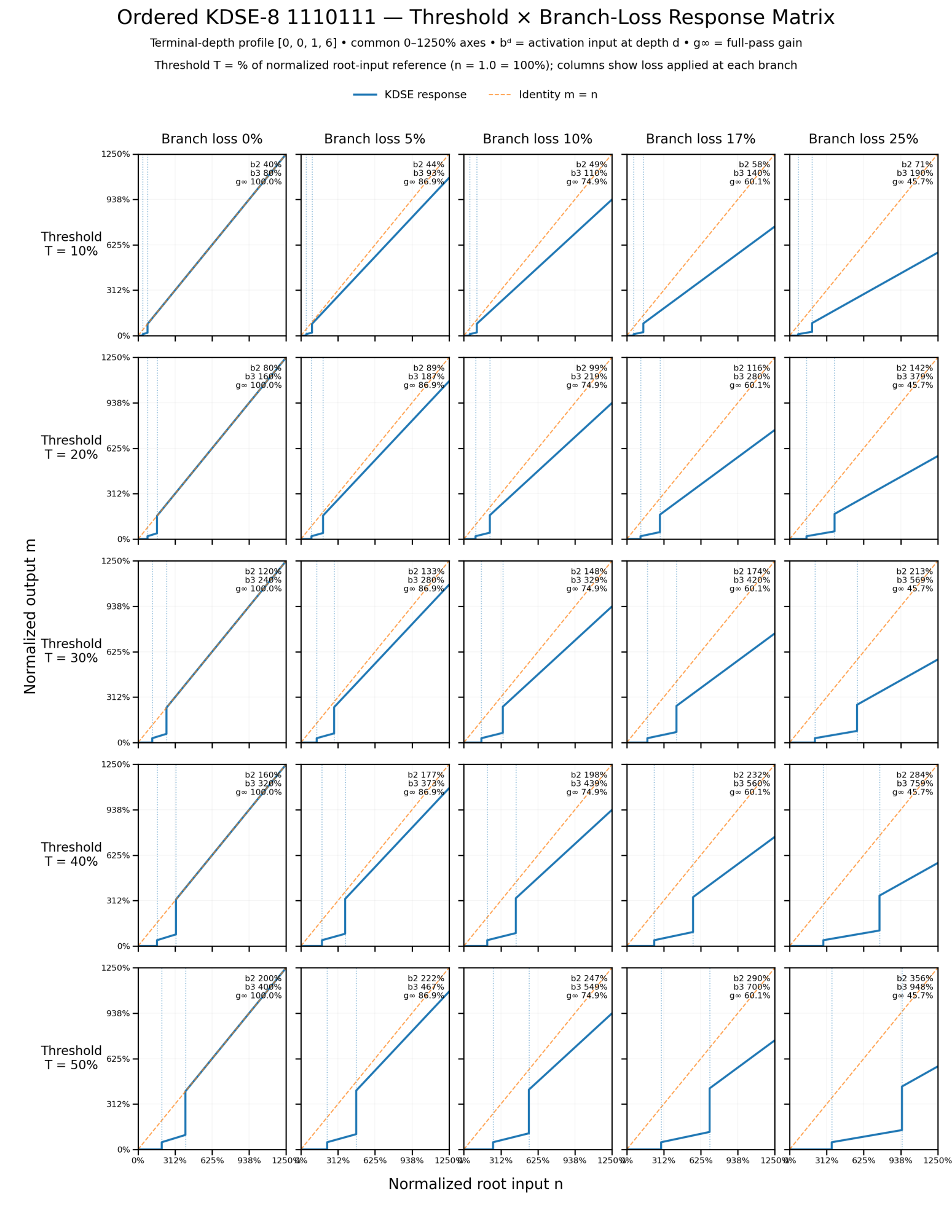
Consequently, changing ℓ moves a jump horizontally and changes the slope added after activation without changing that depth group’s vertical jump magnitude. This invariant geometry is visible across each row of the response atlas.
4.3 Normalized IJM as structural readout
Corollary 2 (Normalized structural readout). Dividing an IJM by the common threshold removes the operator scale:
The collection of normalized IJMs therefore reproduces the nonzero terminal multiplicities of the terminal-depth profile. Define the IJM signature
Normalizing the event coordinates by T gives
For fixed q and branch loss, the normalized response events are therefore determined directly by the KDSE terminal- depth profile. No independent per-jump location or magnitude list is required. The number of distinct grouped IJM events equals the number of occupied terminal depths:
4.4 General multiplicative path-transfer theorem
Theorem 2 — multiplicative path-transfer cancellation For any positive multiplicative root-to-terminal transfer α_j, if the same transferred value is both threshold-tested at T and summed into the output, the terminal enters the response with instantaneous jump magnitude T. A group of r terminals sharing the same transfer coefficient activates together with grouped jump rT.
Let terminal j receive a positive fraction αj of the root input and contribute that transferred value only when it reaches the common threshold T:
The terminal activates at nj = T/αj. At that boundary its individual instantaneous jump is
If r terminals share the same transfer coefficient α_j, they cross threshold at the same input and their individual jumps add to one grouped jump of magnitude rT.
Uniform q-way splitting with uniform branch loss is the structured special case in which every terminal at depth d shares α_d = (a/q)^d and the coincident group size is c_d. If path transfers differ within a depth, same-depth terminals may separate into multiple activation events while the per-terminal cancellation remains exact.
5. Geometry of the response family
5.1 Threshold scales the response
For fixed K, q, and a, changing T scales both axes by the same factor. Writing z = n/T gives
Different threshold rows in the atlas are therefore homothetic copies of the same fixed-loss response geometry. Threshold sets scale; it does not change the occupied-depth order or normalized jump multiplicities.
5.2 Branch loss changes horizontal spacing and retained slope
For successive depths, activation locations obey
Increasing loss expands the horizontal spacing between depth activations. At the same time, each depth’s gain increment contracts by the reciprocal depth factor. The IJM remains fixed because those effects cancel at the activation boundary.
5.3 Full-pass gain as a terminal-depth generating function
Once every terminal is active, the retained gain is
Thus a branch-loss sweep samples the probability-generating function of the intrinsic terminal-depth distribution at a = 1 − ℓ. In particular, g∞(1) = 1 in the lossless case and g∞′(1) = E[D]. This result is not required for the IJM theorem, but it explains why the response columns retain a strong structural order as branch loss varies.
6. Worked KDSE-8 examples
6.1 Ordered value 1110111
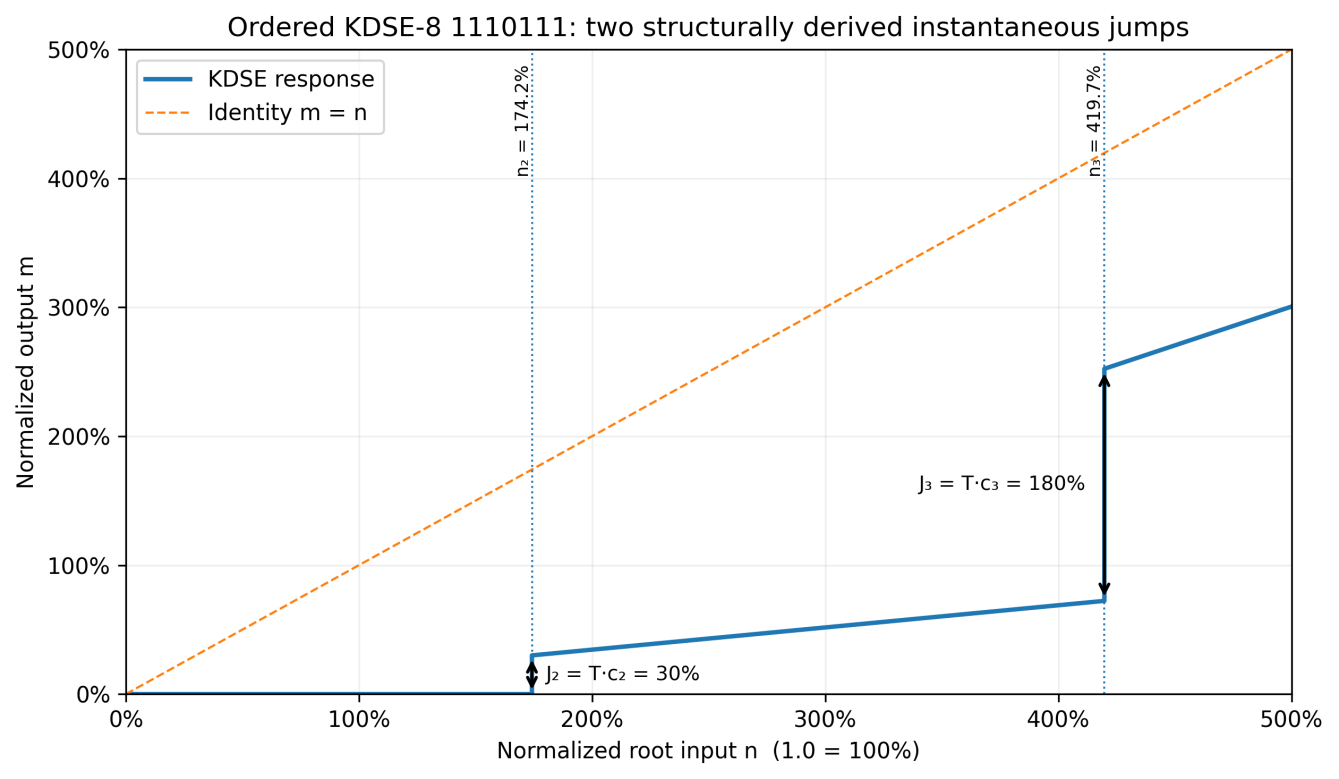
The Ordered payload 1110111 has terminal-depth profile C(K) = [0,0,1,6]. It therefore has two occupied depths and exactly two IJM events under the uniform-loss operator. For q = 2, T = 0.30, and ℓ = 0.17, a = 0.83:
| Depth d | cd | αd | Activation nd | Δgd | IJM Jd |
|---|---|---|---|---|---|
| 2 | 1 | 0.172225 | 1.7419 (174.2%) | 0.172225 | 0.30 (30%) |
| 3 | 6 | 0.071473 | 4.1974 (419.7%) | 0.428840 | 1.80 (180%) |
The full-pass retained gain is approximately 0.6011. At the second event, six depth-3 terminals activate together, producing a grouped jump of 6T = 180%. The large vertical event follows from multiplicity even though the signal delivered to each terminal has traversed three lossy branch stages.
6.2 Ordered value 1010101
The payload 1010101 has C(K) = [0,1,1,1,2]. It has four occupied terminal depths and therefore four grouped IJM events. Their normalized magnitudes are 1, 1, 1, and 2; at threshold T the jumps are T, T, T, and 2T. Branch loss changes the four activation locations geometrically but leaves this jump-magnitude pattern unchanged.
6.3 A deliberate information boundary
Ordered payloads 1110011 and 1110101 are structurally distinct but share C(K) = [0,0,2,4]. Their complete threshold × uniform-branch-loss response sheets are therefore identical. This is an operator projection, not an encoding collision: the present response uses terminal depth but not topology within a depth. A topology-sensitive operator can distinguish the two values because KDSE retains the Ordered topology that this scalar operator ignores.
7. Deterministic construction of the response-event schedule
The response-event schedule can be constructed directly from a valid KDSE value without storing an independent list of jump positions, jump magnitudes, or gain increments. Given K and global q, T, and ℓ:
1. Decode K breadth-first. At each level, obtain the next width from q times the current branch count.
2. Reconstruct the omitted final all-terminal level and accumulate the terminal-depth counts c_d.
3. Set a = 1 − ℓ.
4. For each occupied depth d, compute α_d = (a/q)^d.
5. Compute activation location n_d = T/α_d.
6. Compute gain increment Δg_d = c_d α_d.
7. Compute instantaneous jump magnitude J_d = T c_d.
8. Order the events by d (equivalently by n_d) and accumulate gain to obtain the piecewise-linear response.
profile = terminal_depth_profile(K, q)
a = 1 - loss
gain = 0
for d where profile[d] > 0:
alpha = (a / q) ** d
location = T / alpha
delta_gain = profile[d] * alpha
jump = T * profile[d]
emit(location, jump, delta_gain) Algorithm 1. Direct construction of the response-event schedule and IJM signature from K and global operator parameters.
8. Complete Ordered KDSE-8 IJM signatures
Table 4 lists the 13 Ordered values in the seven-symbol binary KDSE-8 study. The normalized IJM signature lists (depth : Jd/T) for each occupied depth. Because Jd/T = cd, the same signature is the nonzero terminal-depth profile expressed as response events.
| Ordered K | Terminal profile C(K) | Normalized IJM signature (d : Jd/T) | IJM events |
|---|---|---|---|
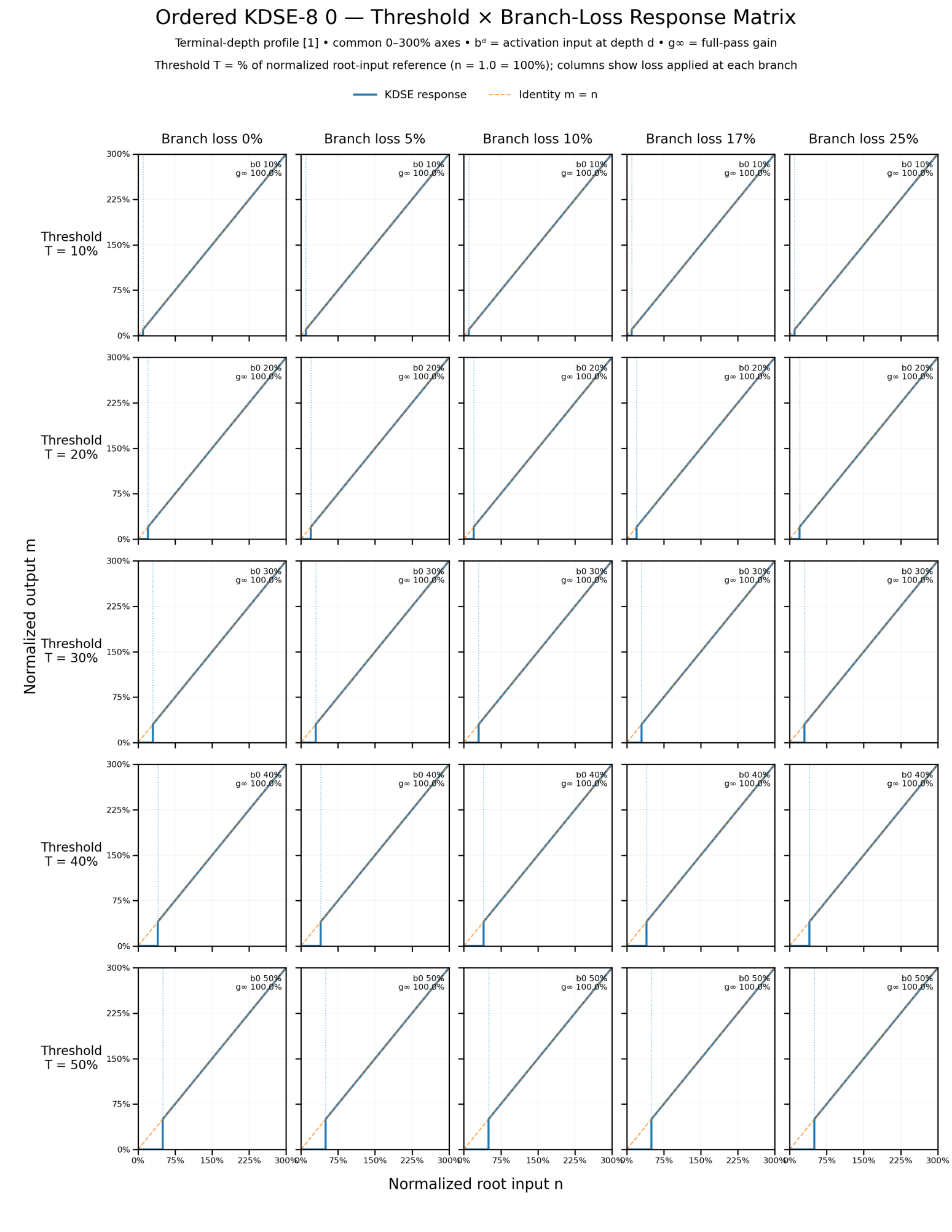
| 0 | [1] | 0:1 | 1 |
| 1 | [0,2] | 1:2 | 1 |
| 101 | [0,1,2] | 1:1; 2:2 | 2 |
| 111 | [0,0,4] | 2:4 | 1 |
| 10101 | [0,1,1,2] | 1:1; 2:1; 3:2 | 3 |
| 10111 | [0,1,0,4] | 1:1; 3:4 | 2 |
| 1010101 | [0,1,1,1,2] | 1:1; 2:1; 3:1; 4:2 | 4 |
| 1010111 | [0,1,1,0,4] | 1:1; 2:1; 4:4 | 3 |
| 1110001 | [0,0,3,2] | 2:3; 3:2 | 2 |
| 1110011 | [0,0,2,4] | 2:2; 3:4 | 2 |
| 1110101 | [0,0,2,4] | 2:2; 3:4 | 2 |
| 1110111 | [0,0,1,6] | 2:1; 3:6 | 2 |
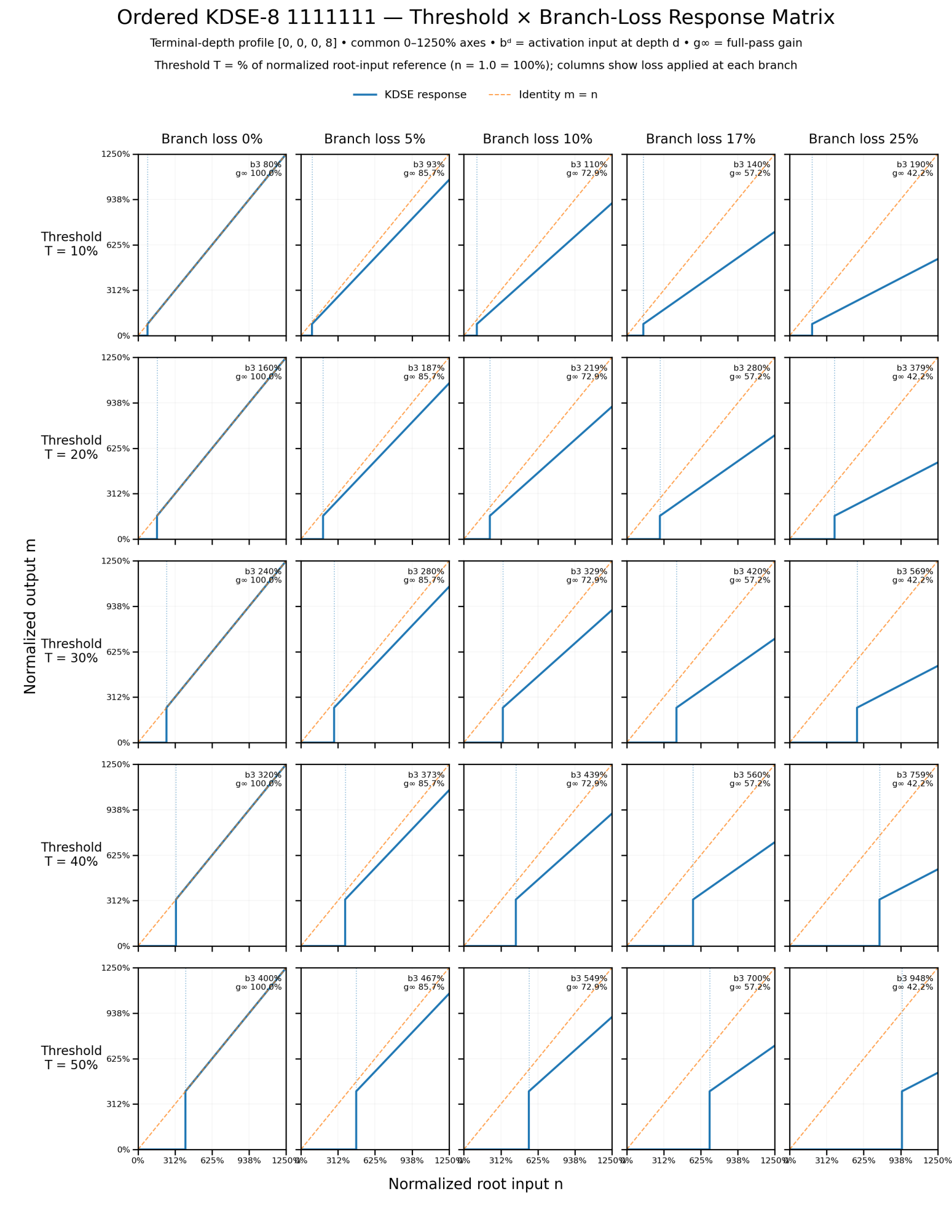
| 1111111 | [0,0,0,8] | 3:8 | 1 |
9. Context: discontinuous and thresholded activations
Discontinuous and thresholded activations provide useful context for the response geometry studied here. Erichson, Yao, and Mahoney introduced JumpReLU, a rectifier with a tunable jump discontinuity [5]. Khalife, Cheng, and Basu analyze the representational structure of neural networks using linear threshold activations [6]. Rajamanoharan et al. later used a discontinuous JumpReLU activation in sparse autoencoders to improve the reconstruction–sparsity trade-off [7]. These examples show that threshold locations and finite discontinuities can be meaningful computational parameters. The role of KDSE here is representational rather than application-specific. The payload does not independently store a bank of threshold units. Instead, compact dendritic structure supplies terminal multiplicities, while q, T, and branch transfer determine activation geometry; the IJM theorem ties each grouped vertical event back to the decoded structure. The same construction may be relevant wherever compact, reproducible, structurally related discontinuities are useful, including neural, event-driven, control, routing, or resource-allocation systems. No such application is required by the encoding or by the theorem.
10. Scope, assumptions, and information boundaries
Operator dependence. IJM is not an intrinsic semantic of KDSE. It is an operator-derived response attribute under the thresholded propagation rule defined here. Another operator may produce continuous responses or different discontinuities. Terminal-depth projection. Uniform q-way splitting with uniform branch loss factors through C(K). It does not expose topology beyond terminal depth; profile-equivalent Ordered values therefore have identical responses under this operator. Common threshold. The grouped identity J_d = T c_d assumes that the terminals in the group use the same threshold T and that the transferred quantity used for thresholding is also the quantity contributed to the output. Multiplicative transfer. The general cancellation theorem assumes positive multiplicative root-to-terminal transfer. Additive offsets, terminal-specific output weights, state, hysteresis, saturation, or post-threshold transformations generally change the jump law. Outer framing. KDSE level boundaries are internally delimiterless, but concatenated variable-length payloads still require an outer framing, container, length, or fixed-width convention. Constrained response family. The operator generates a specific mathematically constrained family of discontinuous responses. Its significance is deterministic structural parameterization, not arbitrary representation of every possible discontinuous function.
11. Conclusion
A simple threshold-and-loss operator exposes a direct relationship between compact KDSE structure and discontinuous scalar response geometry. For every occupied terminal depth d, the decoded profile supplies one grouped activation event. Branch transfer and depth determine its location; terminal multiplicity and threshold determine its instantaneous jump magnitude:
The normalized quantity J_d/T = c_d is therefore a direct structural readout of terminal multiplicity. The collection of events forms an IJM signature derived from K rather than separately parameterized. The general multiplicative- transfer theorem explains the cancellation: any terminal whose positive path transfer is used both to test the threshold and to contribute the transferred value enters with an individual jump T; coincident terminals add into grouped jumps. Within the seven-symbol KDSE-8 payload budget, the 13 Ordered values generate between one and four grouped IJM events under the uniform-loss operator. From the same structural value, the operator deterministically derives event locations, gain increments, cumulative response, and jump magnitudes. Appendix A makes those relationships visible across the complete Ordered KDSE-8 space and across independent threshold and branch-loss sweeps.
Acknowledgment. The phrase “instantaneous jump magnitude” emerged during AI-assisted technical analysis with ChatGPT. The manuscript is authored by Mark Karaman; AI assistance was used for mathematical checking, visualization, literature checking, and editorial drafting.
Licensing note. These papers are released under CC BY-SA 4.0. The accompanying reference implementations are released under AGPL-3.0-or-later. Commercial licensing is available at licensing@uhware.com.
How to cite. Mark Karaman. K — Dendritic Structural Encoding (KDSE): Deterministic Instantaneous Jump Magnitude from Compact Dendritic Structure. August 2026. U.S. Provisional Application No. 64/131,240. Licensed under CC BY-SA 4.0. Reference code: AGPL-3.0-or-later at github.com/uhware/kdse.
References
[1] S. Zaks, “Lexicographic generation of ordered trees,” Theoretical Computer Science, vol. 10, no. 1, pp. 63–82, 1980. doi:10.1016/0304-3975(80)90073-0. [2] G. Jacobson, “Space-efficient static trees and graphs,” Proc. 30th Annual Symposium on Foundations of Computer Science, pp. 549–554, 1989. doi:10.1109/SFCS.1989.63533. [3] J. I. Munro and V. Raman, “Succinct representation of balanced parentheses and static trees,” SIAM Journal on Computing, vol. 31, no. 3, pp. 762–776, 2001. doi:10.1137/S0097539799364092. [4] N. B. Erichson, Z. Yao, and M. W. Mahoney, “JumpReLU: A Retrofit Defense Strategy for Adversarial Attacks,” arXiv:1904.03750, 2019. [5] S. Khalife, H. Cheng, and A. Basu, “Neural networks with linear threshold activations: structure and algorithms,” Mathematical Programming, vol. 206, pp. 333–356, 2024. doi:10.1007/s10107-023-02016-5. [6] S. Rajamanoharan, T. Lieberum, N. Sonnerat, A. Conmy, V. Varma, J. Kramár, and N. Nanda, “Jumping Ahead: Improving Reconstruction Fidelity with JumpReLU Sparse Autoencoders,” International Conference on Learning Representations (ICLR), 2025; arXiv:2407.14435.
Appendix A
Complete Ordered KDSE-8 Threshold × Branch-Loss Response Atlas
Each following sheet holds one Ordered KDSE-8 value fixed while threshold varies by row and uniform per-branch loss varies by column. Threshold T is expressed as a percentage of the normalized root-input reference n = 1.0 = 100%. Each panel annotates activation inputs and full-pass gain. Within a sheet, all panels share one axis range for direct comparison; axis ranges may differ between sheets to preserve informative visual scale. The atlas contains all 13 Ordered values: 0, 1, 101, 111, 10101, 10111, 1010101, 1010111, 1110001, 1110011, 1110101, 1110111, and 1111111. The identical sheets for 1110011 and 1110101 provide a visual demonstration of the terminal-profile information boundary of this operator.